Understanding the Difference Between Smart Manufacturing and Artificial Intelligence
“Is your company focused on artificial intelligence or smart manufacturing?” This question often arises at industry exhibitions. While both terms include the word “smart,” they are fundamentally different. An automation engineer would tell you: a single word can make a world of difference.
Today, I will clarify this distinction using our company’s experience with polishing robots.
Real-World Scenarios
Scenario A: Traditional Automated Production Line
A factory producing automotive parts introduced 10 polishing robots. Each robot performs the same actions based on preset programs. When switching to a different product model, an engineer must manually teach the robot, which can take half a day.
This is automation, the foundation of smart manufacturing, but it lacks true “intelligence.”
Scenario B: Our Intelligent Polishing Workstation
In the same factory, our non-teaching polishing system was implemented. The robot can “see” the workpiece using 3D vision scanning, recognizing shape and size in 1.5 seconds. It can “decide” how to polish by automatically calling upon a process library to plan the optimal path. It can also adjust force in real-time without damaging the base material.
Switching to a new product model? No need for reprogramming; just place it on the workstation, and the robot handles it. This is artificial intelligence empowering smart manufacturing.
The difference? The former is “execution,” while the latter involves “perception + decision-making + execution.”
What is Smart Manufacturing?

Smart manufacturing is a comprehensive system engineering approach that encompasses a wide range of technologies. It includes but is not limited to:
- Automation: Robots, AGVs, automated production lines
- Information Technology: MES (Manufacturing Execution Systems), ERP (Enterprise Resource Planning)
- Internet of Things: Device networking, data collection
- Artificial Intelligence: Machine vision, machine learning, intelligent decision-making
In simple terms, smart manufacturing is the “intelligent upgrade of the manufacturing industry,” aiming to achieve a production model characterized by self-perception, self-decision, self-execution, and self-adaptation. It acts as a large “basket” that incorporates various advanced technologies.
International Definition: Smart manufacturing is a new production method that integrates advanced manufacturing technology with next-generation information and communication technology, covering all aspects of manufacturing activities, including design, production, management, and services, with functions such as self-perception, self-learning, self-decision, self-execution, and self-adaptation.
What is Artificial Intelligence?

Artificial intelligence is the scientific discipline that enables machines to mimic human intelligence. This includes machine learning, computer vision, natural language processing, and knowledge graphs.
In manufacturing, artificial intelligence serves as the “brain.”
For example, in our polishing robot:
- Computer Vision: 3D cameras understand the shape and position of workpieces, even when materials are disorganized.
- Machine Learning: The system trains on data to automatically match optimal process parameters (speed, pressure, feed rate).
- Intelligent Planning: Path planning algorithms generate collision-free, efficient polishing trajectories.
- Adaptive Control: Line lasers track seams and polishing surfaces in real-time, dynamically compensating for thermal deformation and positional deviations.
Without artificial intelligence, smart manufacturing is merely a “shell”—machines can operate automatically but lack the ability to think, adapt, or optimize.
The Relationship Between the Two

To illustrate:
- Smart manufacturing is the entire smart factory, encompassing robots, conveyor belts, control systems, and management software—it’s a complete ecosystem.
- Artificial intelligence is the factory’s “brain,” responsible for perception, decision-making, learning, and optimization.
To be more vivid:
- Smart manufacturing is a symphony orchestra with various instruments (equipment), scores (programs), and conductors (MES).
- Artificial intelligence is the principal conductor, able to adjust tempo, coordinate sections, and improvise based on the situation.
Without artificial intelligence in smart manufacturing: A robot running on a fixed program can work but is inflexible—changing products requires reprogramming, and it cannot adjust to deviations.
With artificial intelligence in smart manufacturing: The robot can see, think, and adapt, functioning like a skilled worker.
Our Practice: Illuminating Smart Manufacturing with Artificial Intelligence
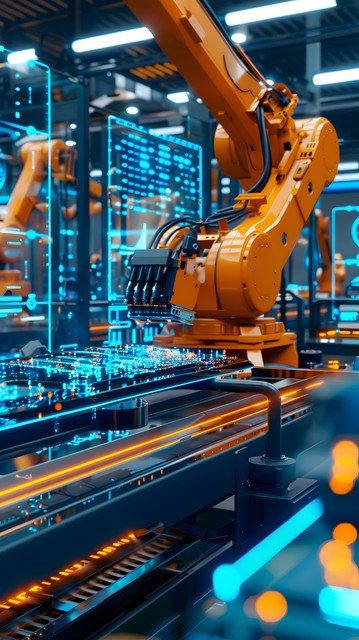
We focus on intelligent robots for heavy industry, specifically in polishing, cutting, welding, and material handling.
Traditional smart manufacturing solutions (common among peers) involve equipping robots with an automation system to perform tasks based on teaching programs. The advantage is stability, but the downside is inflexibility—small batch, diverse products can be challenging.
Our artificial intelligence solution: Builds on automation by adding 3D vision, non-teaching algorithms, force control technology, and dynamic tracking. Robots are no longer “blind” but are intelligent agents with “eyes and brains.”
Two Core Differences:
| Dimension | Traditional Smart Manufacturing (Automation) | AI-Empowered Smart Manufacturing |
|---|---|---|
| Changeover Method | Manual teaching programming, half a day to days | Visual recognition for automatic changeover, 3 minutes |
| Handling Deviations | Cannot handle, requires manual intervention | Dynamic tracking for real-time compensation |
| Worker Role | Operators, programmers | Equipment managers, process optimizers |
| Applicable Scenarios | Large batch, few varieties | Diverse products, small batches, flexible production |
Our Positioning: We do not aim to create a general smart manufacturing platform but to solve “flexibility” and “adaptability” challenges using artificial intelligence technology in specific scenarios like polishing and cutting.
Conclusion: Stop Confusing the Two
- Smart manufacturing is the “skeleton + muscles”: It includes automation equipment, information systems, IoT, etc., forming the overall framework for upgrading the manufacturing industry.
- Artificial intelligence is the “brain”: It is responsible for perception, decision-making, learning, and optimization, key to making manufacturing systems truly “intelligent.”
The relationship between the two: Artificial intelligence is the core driving force of smart manufacturing. Without AI, smart manufacturing can only be termed “automation”; with AI, it achieves self-perception, self-decision, and self-adaptation.

Next time someone asks you, “What is the difference between smart manufacturing and artificial intelligence?” you can respond:
Smart manufacturing is a smart factory, and artificial intelligence is the chief engineer within that factory. A factory can operate without a chief engineer, but only with one can it adapt to changes and optimize performance.
Comments
Discussion is powered by Giscus (GitHub Discussions). Add
repo,repoID,category, andcategoryIDunder[params.comments.giscus]inhugo.tomlusing the values from the Giscus setup tool.